
Loading

- Home
- About Tradex
- Products & Services
- Foodservice
- Seafood News
- School of Fish

EP 809 | AIRED 09/07/2026
Pacific Cod Market Update: Alaska B-Season Could Shift the Supply Outlook
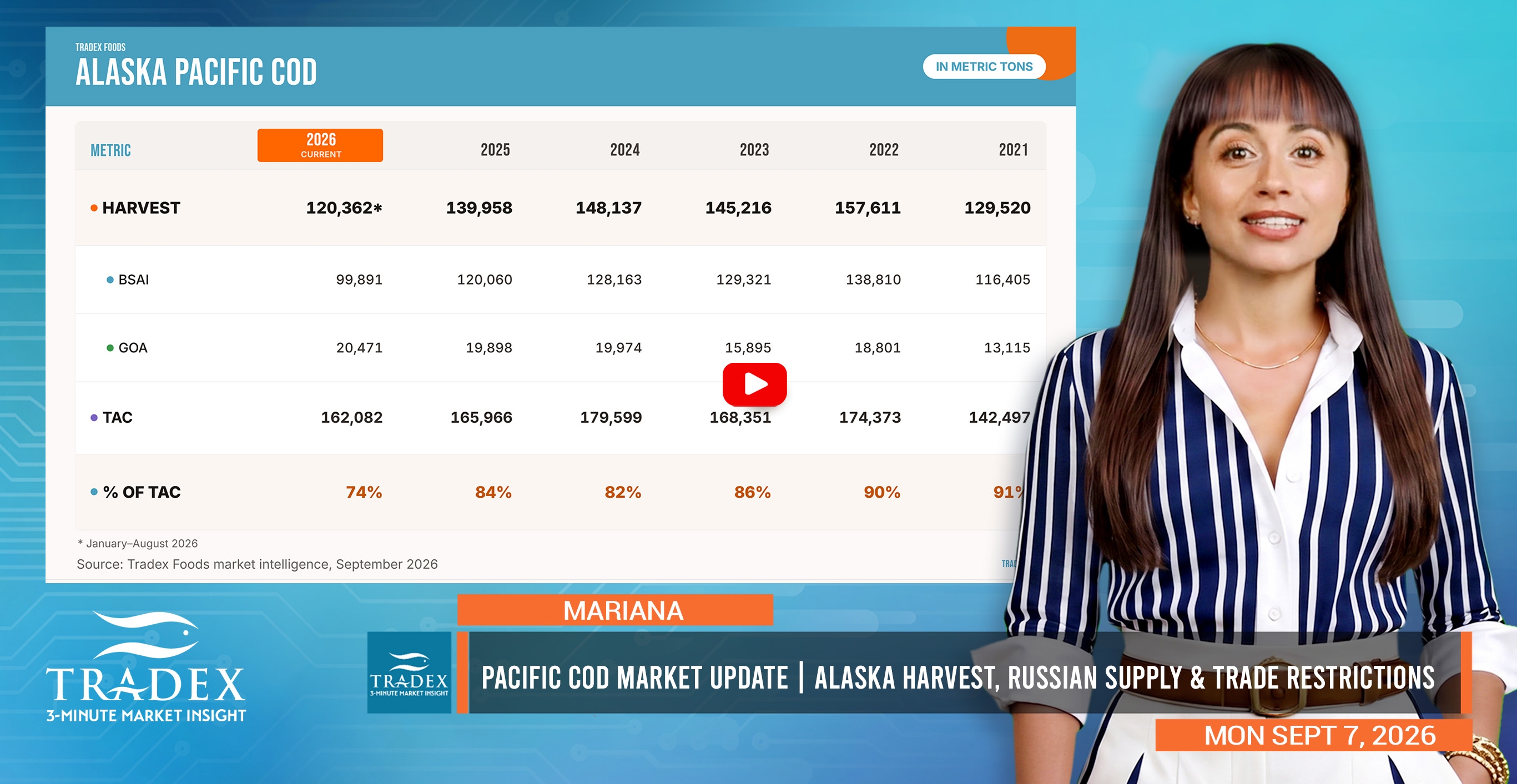
September 7, 2026 - The Pacific cod market remains firm as the industry enters the final months of 2026. Alaska has harvested approximately 117,677 metric tons, or 69% of its combined 171,032 metric ton TAC, with current production running roughly 7% ahead of the comparable period in 2025. Importantly, significant B-season fishing remains through the fall and into December, leaving meaningful opportunity for additional Alaska production before year-end.

In the Bering Sea and Aleutian Islands (BSAI), approximately 98,221 metric tons has been harvested against a 2026 TAC of 140,979 metric tons. This compares with approximately 95,307 metric tons at the comparable point last year. The Gulf of Alaska (GOA) has harvested approximately 19,456 metric tons, compared with roughly 14,941 metric tons during the comparable 2025 period. With a 2026 GOA TAC of approximately 30,053 metric tons, considerable production opportunity remains. Combined, Alaska is currently ahead of last year's comparable harvest pace, while several fisheries continue through the fall and into December. The strength of the B-season harvest will therefore be one of the most important factors determining Pacific cod availability through the remainder of 2026.
Russia Remains the Greater Supply Concern
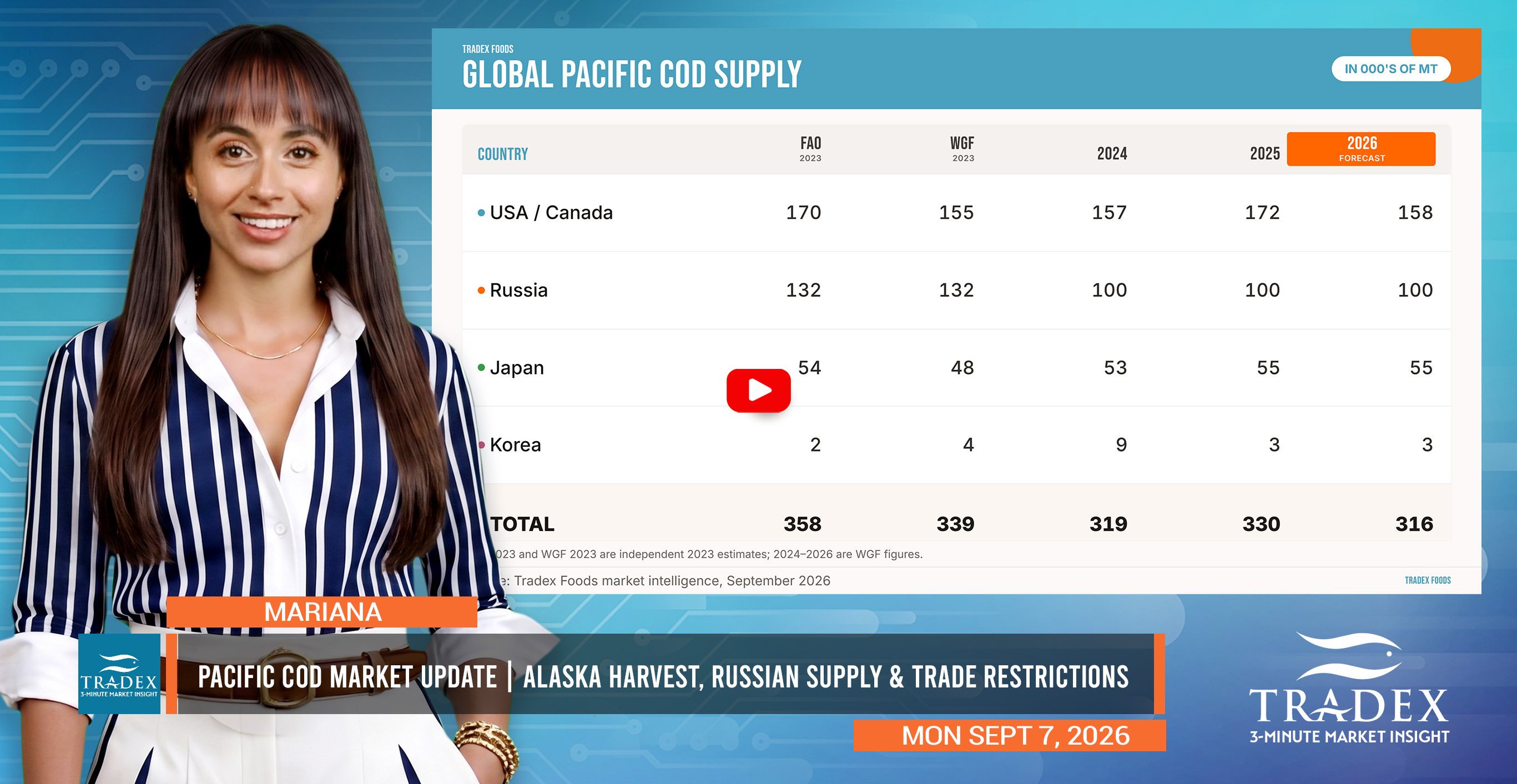
Russia presents a more structural constraint on Pacific cod supply. Current Russian harvest is approximately 88,400 metric tons against a 2026 TAC of 134,900 metric tons. The longer-term trend is also significant. Russian Pacific cod TAC has fallen from approximately 212,880 metric tons in 2021 to 134,900 metric tons in 2026, a decline of roughly 37%. This substantially smaller resource base continues to limit Russian production potential compared with earlier years.
Trade Restrictions Limit US Supply Options
For US buyers, global production figures do not tell the entire supply story. Russian-origin cod is prohibited from entering the United States, including Russian cod processed through third countries. As a result, Russian Pacific cod can continue supplying eligible international markets but cannot provide replacement supply to US buyers when Alaska-origin product becomes tight. This market segmentation increases the importance of Alaska production and means additional Russian availability does not necessarily translate into greater Pacific cod availability for the US market.
Global Supply Remains Constrained
The Groundfish Forum forecasts global Pacific cod production at approximately 316,000 metric tons in 2026, down from approximately 330,000 metric tons in 2025. While Alaska has the potential to add meaningful production through the remainder of the year, the broader global supply picture remains relatively tight. Recent China market indications put Russian longline H&G around $9,000 per metric ton, while US longline H&G is approximately $9,600 to $9,800 per metric ton. Pacific cod loins are indicated around $7.00 per pound FOB China, while 50–52% moisture migas remains extremely short at more than $10,000 per metric ton.

Advertise Here: advertising@tradexfoods.com
What Buyers Should Watch
The key market indicator is now Alaska's September-through-December production. A strong B-season harvest could increase raw-material availability and create some relief for buyers. However, structurally lower Russian supply and restrictions preventing Russian-origin cod from entering the US should continue supporting US-origin Pacific cod values.
Our Recommendation is that buyers protect near-term Pacific cod requirements while closely monitoring Alaska's B-season harvest. Stronger fall production could create buying opportunities, while any slowdown would reinforce tight US availability and elevated replacement costs.
--- If you’re not already, be sure to subscribe to our 3-Minute Market Insight for seafood updates and insights delivered right to your inbox.