
Loading

- Home
- About Tradex
- Products & Services
- Foodservice
- Seafood News
- School of Fish

EP 810 | AIRED 09/14/2026
Atlantic Cod Market Update: Lower Harvests Keep Approved-Origin Supply Tight
September 14, 2026 - The global Atlantic cod market remains structurally tight as lower quotas and declining harvests continue to restrict raw-material availability. Although Russian H&G Atlantic cod prices have softened slightly in China, the correction appears to be driven by slower immediate demand rather than a meaningful improvement in the global supply outlook.
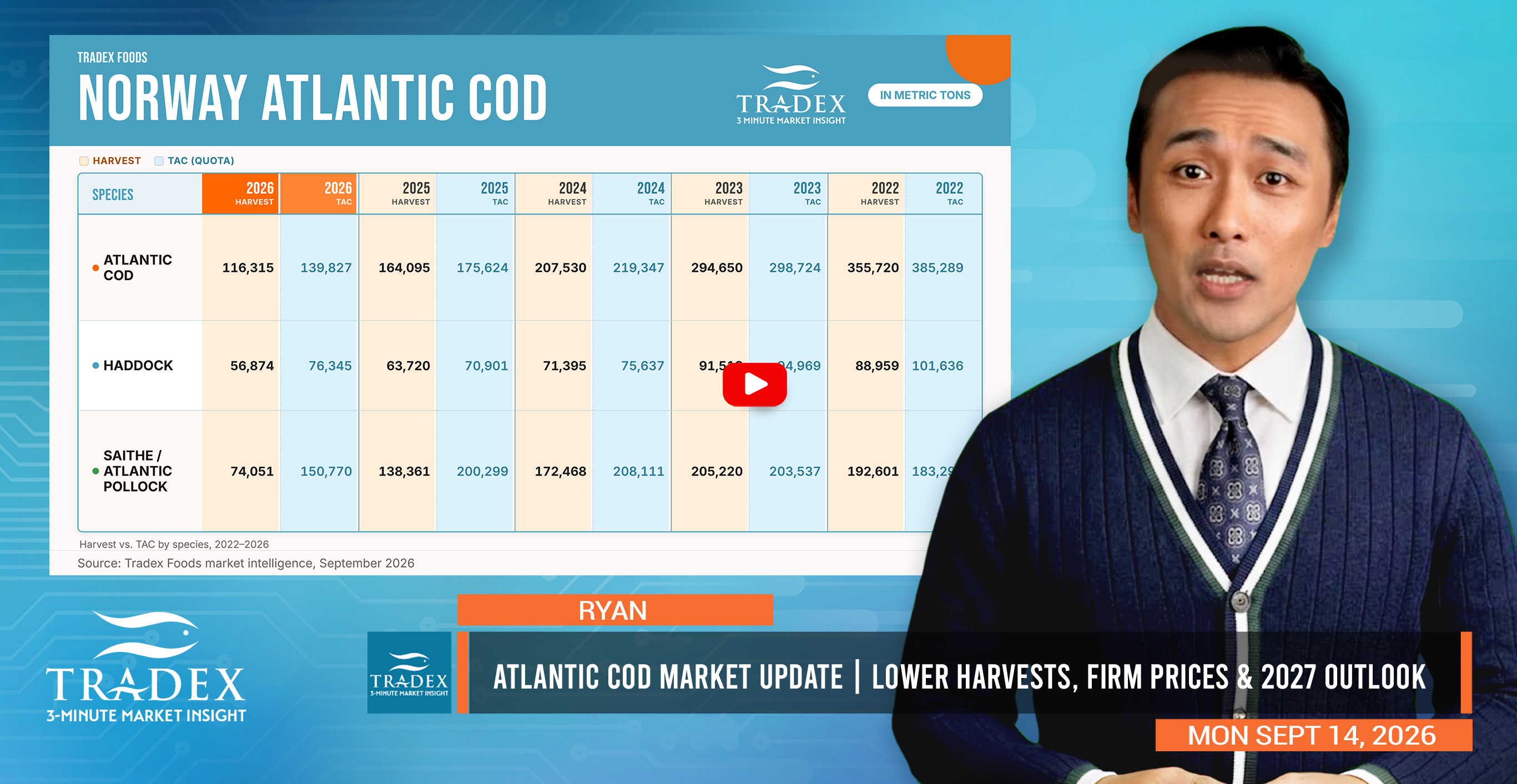
Northeast Arctic Cod Quota Falls to Lowest Level Since 1991
The 2026 Northeast Arctic cod quota was reduced by 16% to 285,000 metric tons, its lowest level since 1991. Norway received approximately 140,000 MT, while Russia received approximately 145,000 MT.
The reduction follows several consecutive years of tightening quotas designed to lower fishing pressure and support rebuilding of the Barents Sea cod stock. As a result, significantly less raw material is available to support frozen H&G, fillet, block, salted and dried Atlantic cod programs.
Norway had harvested approximately 116,000 MT through week 36, down 16% from the comparable 2025 period. More than 80% of the country’s adjusted quota had already been harvested, leaving approximately 27,000 MT available for the remainder of the year.
Russia had landed approximately 107,000 MT against its 145,000 MT allocation. Russian cod remains an important source of H&G raw material for China and other accepting markets; however, Russian-origin seafood cannot enter the United States, including when processed through third countries. This restriction prevents Russian supply from directly offsetting reduced approved-origin availability for American buyers.
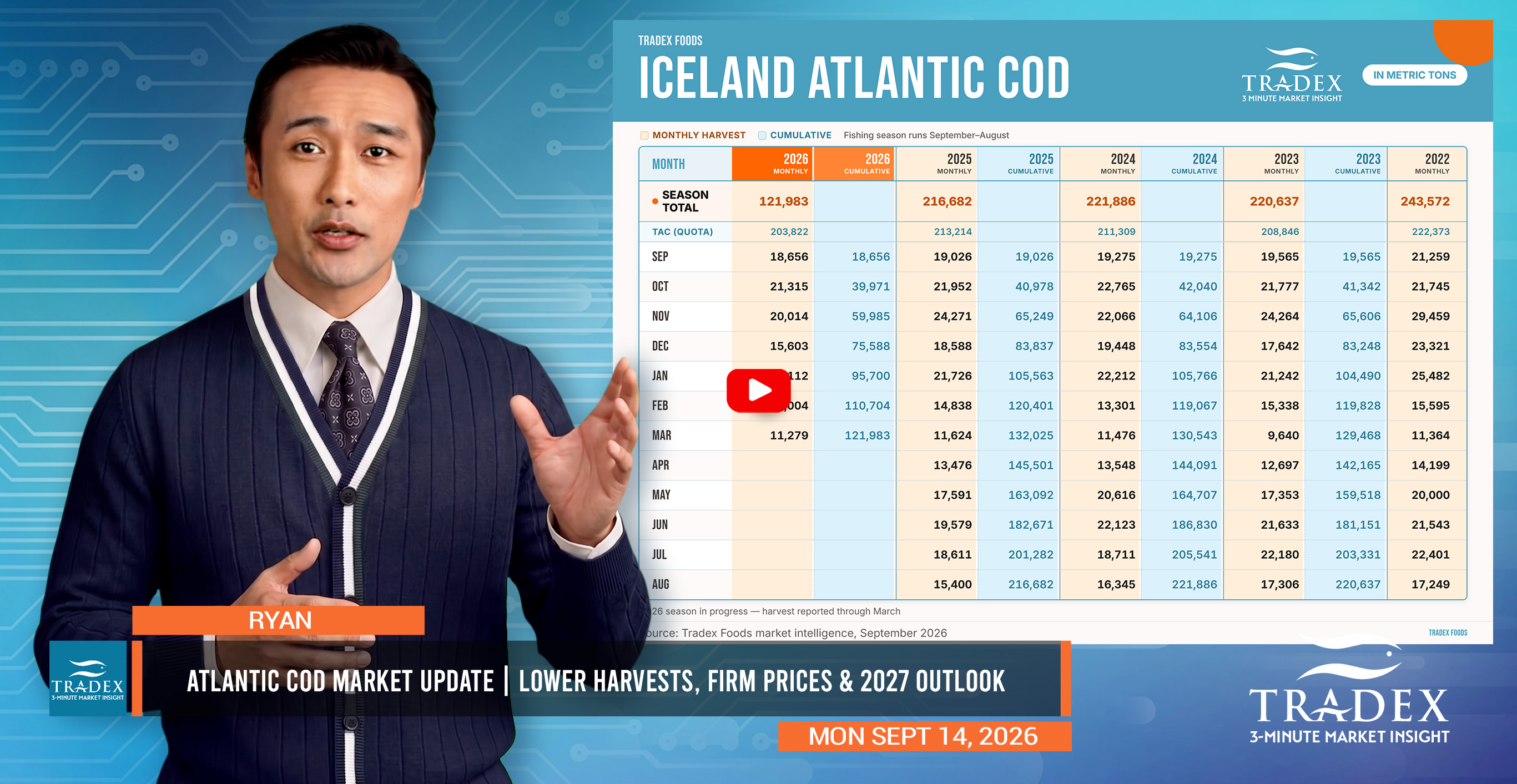
Iceland has provided greater supply stability, although its cod harvest is also trending lower. Icelandic cod landings reached approximately 122,000 MT through July, nearly 8% below the same period last year. The country’s current fishing-year cod quota is approximately 204,000 MT, slightly below the previous season.
Global Atlantic Cod Supply Continues to Contract
Norway, Russia and Iceland are expected to produce approximately 454,000 MT of Atlantic cod in 2026. These three origins represent more than 70% of the projected global harvest and therefore remain central to Atlantic cod pricing and availability.
The Groundfish Forum forecasts global Atlantic cod catches of approximately 640,000 MT in 2026. This would represent an 11% decline from 2025 and a reduction of roughly one-third compared with the approximately 954,000 MT harvested in 2023.
The decline does not affect every product form equally. Russia is particularly important to the frozen H&G market, while Iceland is a major supplier of frozen Atlantic cod fillets and blocks. Norway’s cod harvest is distributed across fresh, frozen H&G, fillet, salted and dried production. Declining harvests can therefore create different levels of exposure depending on the required origin, product form and size specification.
Atlantic Cod Prices Show Regional Divergence
Atlantic cod purchasing in China has largely paused as processors hold substantial inventories and anticipate further price declines. Current raw-material indications place Norwegian MSC FAS cod at approximately $10,200–$10,500 per metric ton, while Greenland shore-frozen non-MSC cod is around $7,000 per metric ton. No current Russian MSC FAS offers have been reported.
The wide price difference between origins reflects variations in certification, freezing method, market eligibility and supply availability. Although China’s high inventories are creating short-term downward pressure, the broader Atlantic cod supply outlook remains constrained, particularly for approved-origin and specification-sensitive programs.
However, approved-origin Atlantic cod pricing remains firm. Norwegian frozen whole cod averaged approximately NOK 103 per kilogram during week 36, up 23% year over year. Frozen Atlantic cod fillets averaged approximately NOK 179 per kilogram, an increase of approximately 28%.
Year-to-date Norwegian frozen whole cod export volume was approximately 36% below the comparable 2025 period, while average pricing was approximately 28% higher. These figures demonstrate that lower supply continues supporting replacement costs despite weaker short-term demand in China.

Advertise Here: advertising@tradexfoods.com
Could the 2027 Cod Quota Provide Relief?
Scientists have recommended increasing the 2027 Barents Sea cod quota by 10% to approximately 313,000 MT. The recommendation reflects an improving contribution from the 2021 year class entering the fishable stock.
However, the 2027 quota has not been finalized. Even if the full increase is approved, the proposed volume would recover only part of the supply lost during several consecutive years of quota reductions. The spawning stock also remains historically weak, suggesting that any recovery in Atlantic cod availability is likely to be gradual.
Atlantic Cod Outlook for Seafood Buyers
The current Chinese price correction offers a tactical opportunity for buyers able to use Russian H&G cod. However, it should not be interpreted as the beginning of a broad Atlantic cod market decline. Global catches remain substantially below recent historical levels, Norwegian export availability is lower and approved-origin replacement costs remain firm.
Our recommendation is that buyers use current China-market softness to negotiate near-term H&G coverage while protecting frozen fillet, block and larger approved-origin requirements. Purchasing decisions should remain focused on origin, specification and market eligibility, as tightening approved-origin supply could have a greater effect on replacement costs in the months ahead.
--- If you’re not already, be sure to subscribe to our 3-Minute Market Insight for seafood updates and insights delivered right to your inbox.