
Loading

- Home
- About Tradex
- Products & Services
- Foodservice
- Seafood News
- School of Fish

EP 813 | AIRED 10/05/2026
2026 Wild Pacific Salmon Outlook: Q4 Focus Shifts to Inventory and Replacement Costs
October 5, 2026 - Wild Pacific salmon enters Q4 with the 2026 supply picture increasingly defined. Alaska’s main season is essentially complete, Russia remains dramatically behind its preseason forecast, and Japan’s fall chum fishery continues to develop. With the major harvest windows closing, buyer attention is shifting away from anticipated production and toward available inventory, replacement costs and market-access constraints.

Russia’s 2026 salmon season has underperformed much more severely. Through September 28, approximately 98,000 MT had been harvested, representing just 43% of its 229,000 MT preseason forecast. Based on historical forecast-to-harvest comparisons, this is the lowest harvest-to-forecast level in at least 15 years. Pink production is effectively complete, while chum is now responsible for virtually all meaningful late-season growth. Russia’s harvest includes approximately 41,600 MT pink, 34,100 MT chum, 18,800 MT sockeye and 3,600 MT coho.
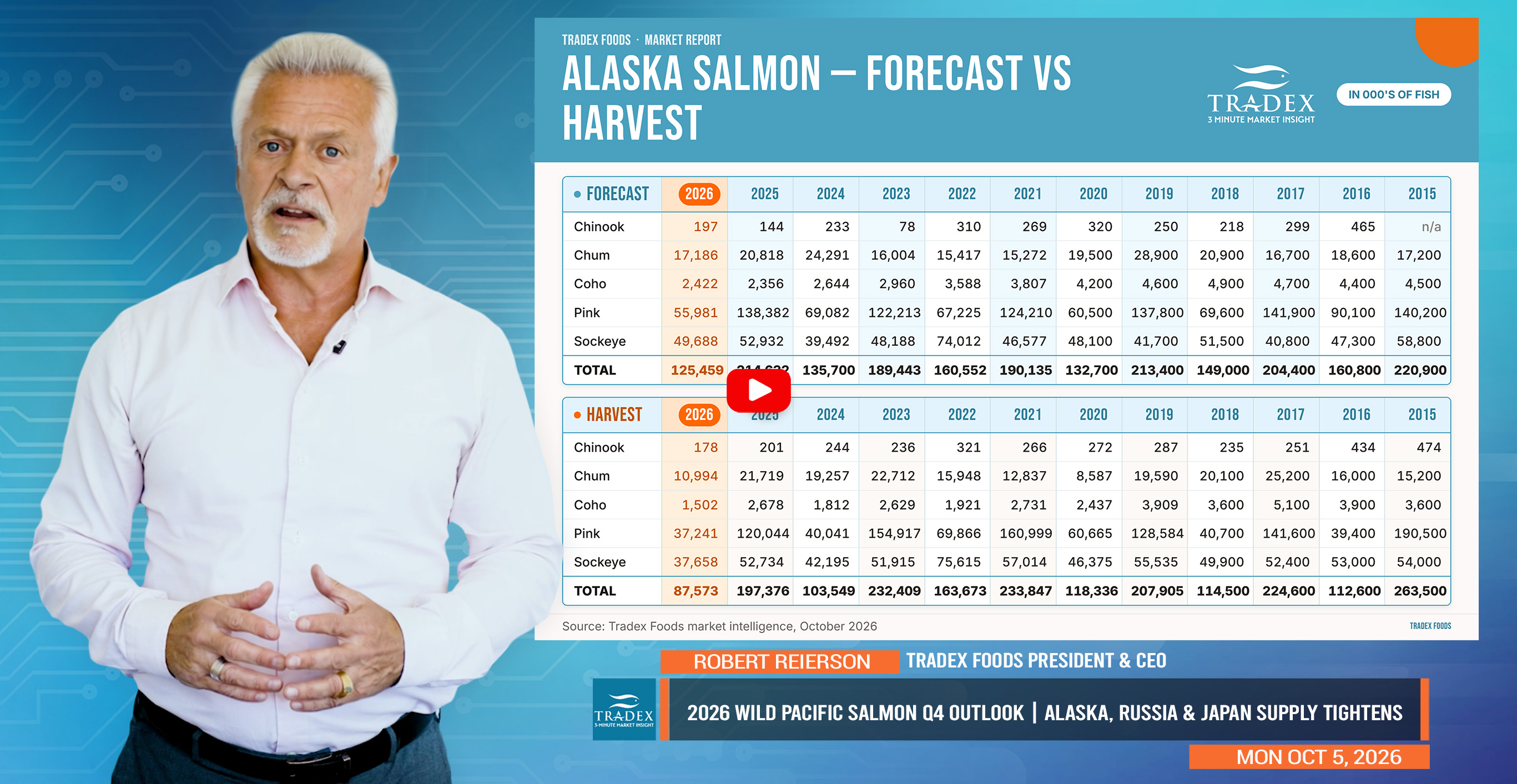
The remaining North American fisheries are unlikely to materially alter the broader supply picture. Alaska will continue to see some localized coho production, while British Columbia may provide additional Canadian-origin salmon; however, these late fisheries are expected to provide only incremental relief to the wider North Pacific supply shortfall.
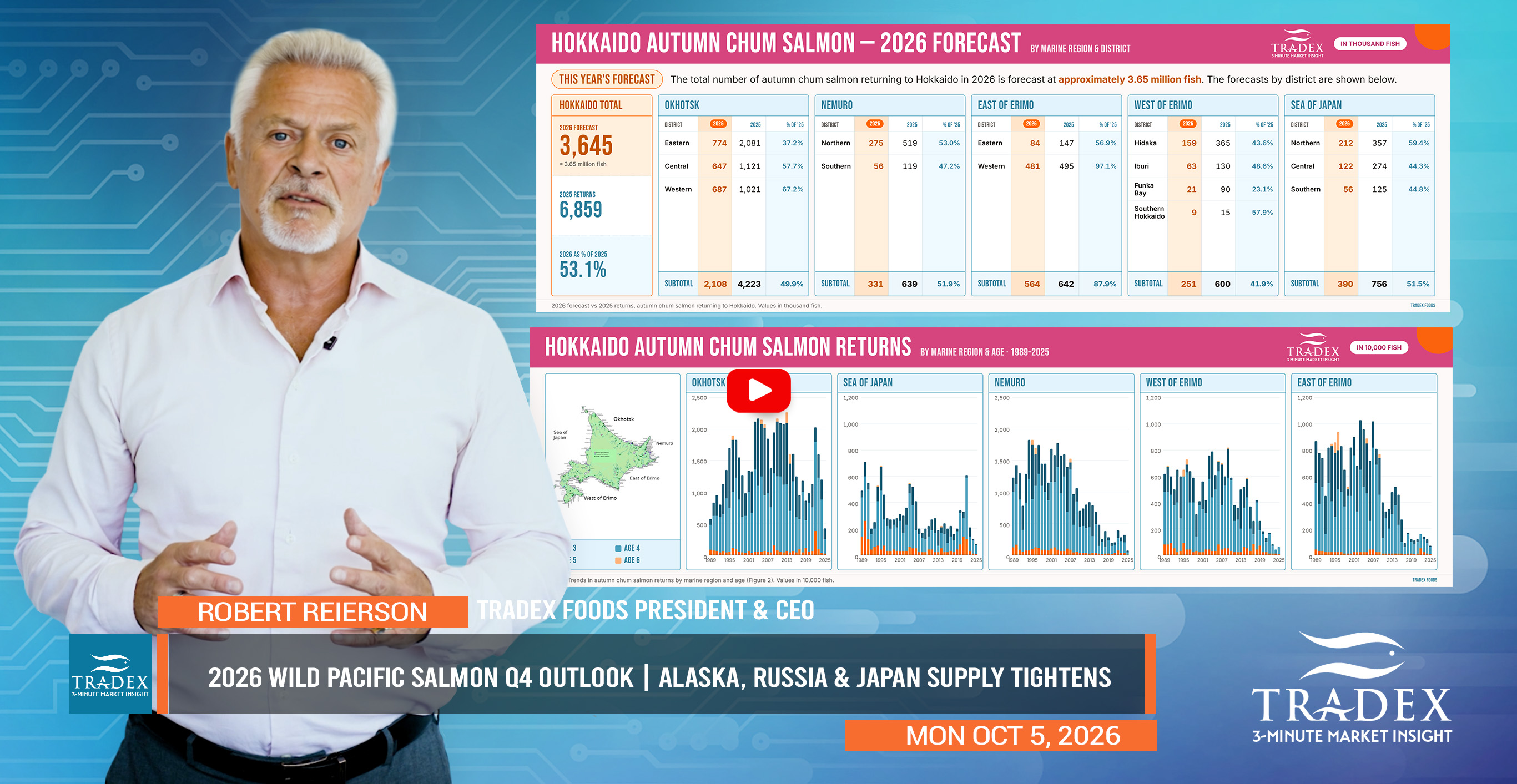
Japan remains the key fall fishery to monitor. Hokkaido’s 2026 autumn chum return forecast is approximately 3.65 million fish, only 53.1% of the 2025 return level, meaning the forecast is about 47% lower year over year. The 2025 return itself had already fallen to 6.86 million fish, the lowest level since 1989, and achieved only 60% of that year’s forecast. 20260928-losos-putina(2) The 2026 forecast therefore begins from an already historically weak base, with the Hokkaido Research Organization expecting just 3.645 million returning chum across the island.

Advertise Here: advertising@tradexfoods.com
Commercial Hokkaido harvest through September 26 was only about 4,000 MT, down approximately 37% from 2025 and 65% from 2024 at the same point. Fishing will continue through the fall, leaving additional chum and roe production possible, but the scale of any meaningful supply recovery remains limited.
Current global wild salmon harvest can be estimated at approximately 300,000 MT, with Alaska, Russia and Japan accounting for nearly all reported production to date. This is less than half of the approximately 745,000 MT harvested in 2025. Additional late-season production will raise the final total, but 2026 is shaping up to be an exceptionally low-production year and could ultimately rank among the weakest global wild salmon harvests in modern history.
For buyers, total harvest is only part of the supply equation. Russian-origin salmon cannot replace reduced Alaska production in the U.S. market, making accessible supply more restrictive than headline global production figures suggest. This is particularly important for pink salmon, canned programs, chum and roe, where reduced production and regional trade restrictions may continue to support replacement costs into Q4.
Our recommendation is that buyers closely review remaining Q4 requirements and protect committed pink salmon, canned-salmon, chum and roe needs where supply certainty is important. Remaining chum opportunities should be evaluated selectively, while Russia and Japan’s October production should be monitored closely before assuming meaningful additional supply or significant price relief.
--- If you’re not already, be sure to subscribe to our 3-Minute Market Insight for seafood updates and insights delivered right to your inbox.