
Loading

- Home
- About Tradex
- Products & Services
- Foodservice
- Seafood News
- School of Fish

EP 814 | AIRED 10/12/2026
Alaska Crab Market Outlook: New King, Bairdi and Snow Crab Quotas for Winter 2026/27
October 12, 2026 - Alaska’s upcoming crab season presents different supply outlooks for seafood buyers. Larger Bairdi and Bristol Bay red king crab quotas create opportunities for winter programs, while a sharp reduction in Bering Sea Opilio snow crab limits Alaska’s contribution to supply. With Canadian snow crab harvesting complete until next spring, winter availability will depend on species, remaining inventory and when Alaska’s new production reaches the market.

Bairdi Quota Increases 185%
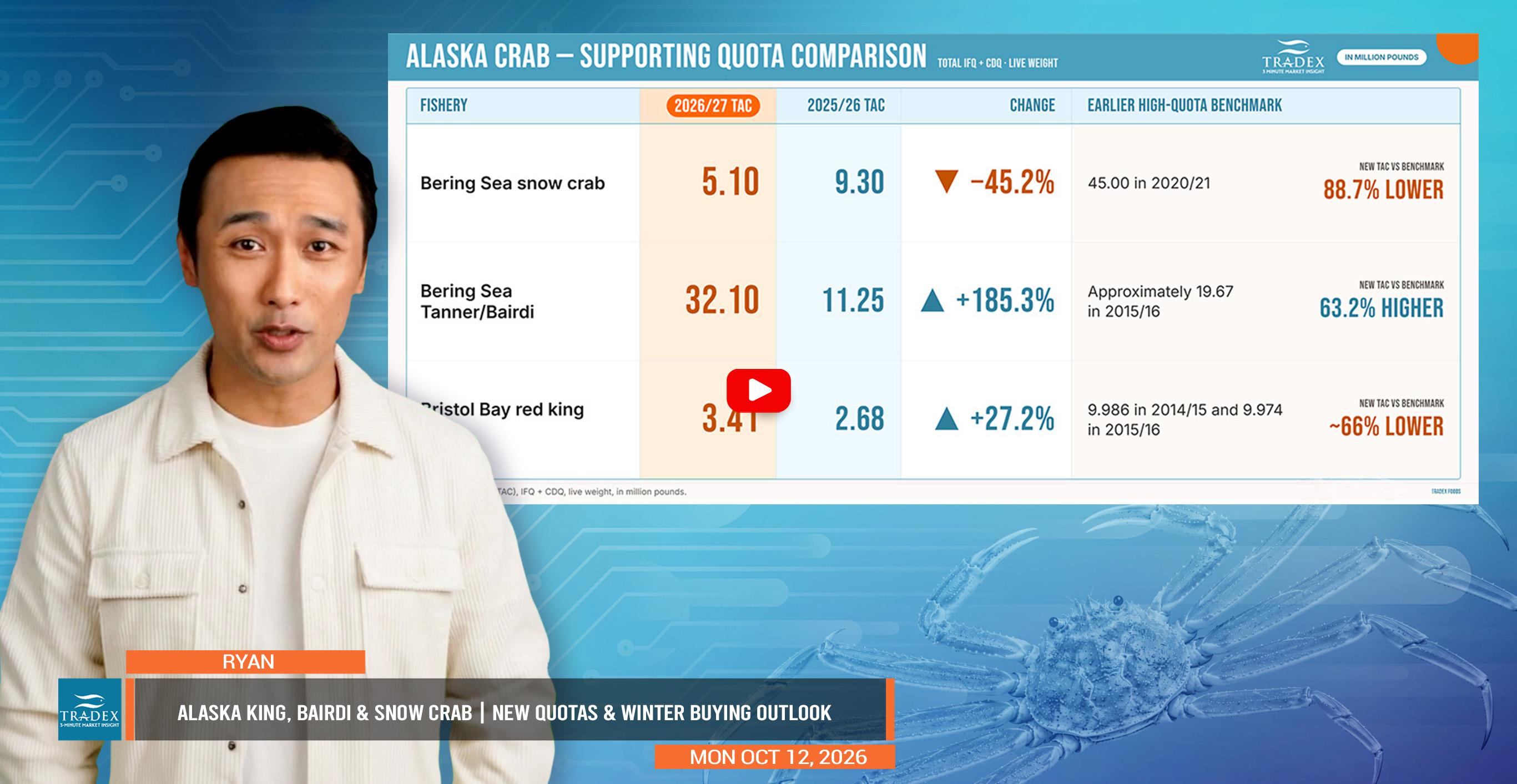
Bering Sea Tanner crab, commonly known as Bairdi and also sold as snow crab in the marketplace, delivers the largest quota increase. The combined 2026/27 allocation reaches 32.1 million pounds, up 185% from 11.25 million pounds last season.
The western Bering Sea accounts for 27.2 million pounds, with another 4.9 million pounds allocated to the eastern area. This expanded quota creates meaningful opportunities for larger-cluster programs, winter promotions and suitable substitutions as production develops.
Although Bairdi and Opilio are both marketed as snow crab, buyers should assess their suitability against specific product requirements. Actual landings, cluster sizes and finished-product availability will determine how effectively the increased Bairdi allocation translates into purchasing opportunities.
Red King Crab Offers Improved Holiday Supply
The Bristol Bay red king crab quota increases to 3.41 million pounds, up 27% from 2.68 million pounds last season. Supply remains well below the abundance seen more than a decade ago, but the increase should support improved holiday availability.
For buyers, the larger allocation provides additional purchasing potential. However, production timing, size distribution and confirmed customer demand remain central to planning holiday and winter coverage.

Advertise Here: advertising@tradexfoods.com
Alaska Opilio Snow Crab Quota Falls 45%
Bering Sea Opilio snow crab moves in the opposite direction. The new quota is 5.1 million pounds, down 45% from last season’s 9.3 million pounds.
The allocation is slightly above the 4.72 million pounds permitted when the fishery reopened in 2024/25, but remains almost 89% below the 45-million-pound quota in 2020/21. Approximately 45 million pounds were actually harvested during that earlier season, illustrating how substantially Alaska’s snow crab contribution has contracted.
The increase in Bairdi therefore needs to be considered alongside the reduction in Opilio. Buyers planning species-specific programs should review each supply outlook separately when evaluating winter requirements.
Canada’s Offseason Places Greater Focus on Inventory
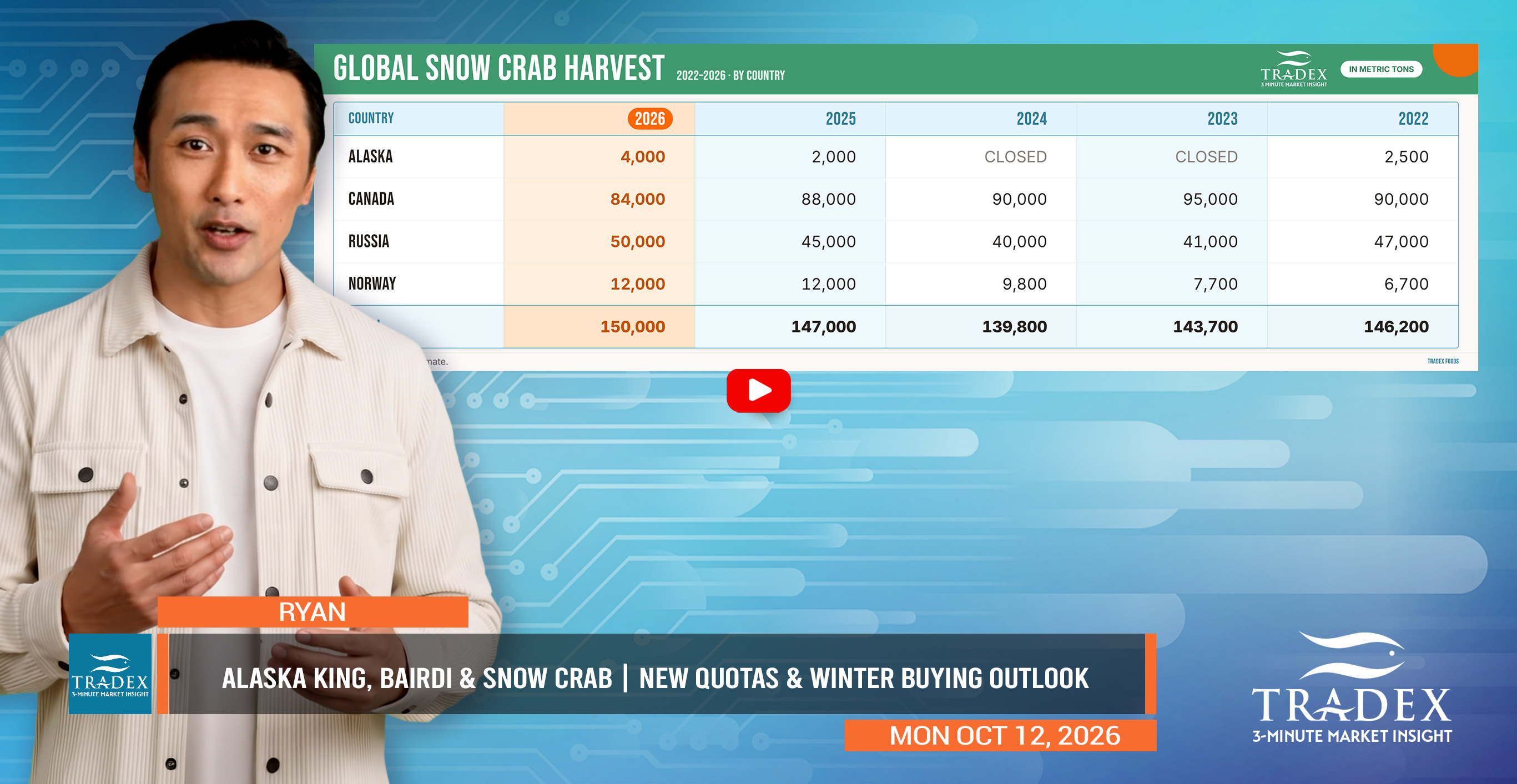
Canada’s 2026 snow crab season is complete, with reported landings of approximately 83,000 metric tonnes. Although substantial, the volume is described as the lowest in recent years. New Canadian harvesting is not expected until spring 2027, with opening dates still to be determined.
Much of this year’s production has already shipped or been committed, increasing the importance of understanding where remaining inventory sits. Limited availability at processors does not necessarily mean limited stock throughout U.S. distribution, where previously imported product may still be available.
Winter purchasing decisions will consequently depend on accessible inventory, product specifications and replacement costs, alongside the timing of Alaska’s new production.
Russia’s Harvest Does Not Directly Translate Into U.S. Availability
Russia remains a major snow crab producer, with its 2026 catch limit set at approximately 50,000 metric tonnes, compared with a reported harvest of approximately 44,000 metric tonnes in 2025.
Russia’s autumn king crab harvest is also underway. Reported Far East production is heavily oriented toward live crab, while Barents Sea vessels also produce frozen product. Larger harvests therefore do not automatically translate into greater availability of frozen legs and clusters.
Market access further shapes the supply picture. Russian-origin crab remains prohibited from entering the United States, including after processing in another country. Buyers must consider product form and destination-market access when assessing the effect of Russian production on available supply.
Our Recommendation
Our recommendation is that buyers secure essential snow crab requirements through Canada’s offseason, consider the expanded Bairdi supply for winter promotions and suitable substitutions, and purchase red king crab against confirmed demand. Review actual landings, size distribution and finished-product offers before extending coverage. Higher quotas create opportunities, but consumer demand will determine how quickly that supply moves.
--- If you’re not already, be sure to subscribe to our 3-Minute Market Insight for seafood updates and insights delivered right to your inbox.