
Loading

- Home
- About Tradex
- Products & Services
- Foodservice
- Seafood News
- School of Fish

EP 816 | AIRED 10/26/2026
Pacific Halibut: The Final Stretch — Winter Supply and the 2027 Outlook
October 26, 2026 - Pacific halibut’s major commercial fisheries are entering the final stretch, with key producing regions between 86 and 90 percent of their commercial limits. For seafood buyers, the focus is shifting toward how much remaining production will become available for winter programs, particularly frozen headed-and-gutted (H&G) halibut, fillets and fletches.
With commercial allocations increasingly utilized and earlier market feedback pointing to limited freezer production, buyers should assess winter requirements against confirmed supplier inventories.

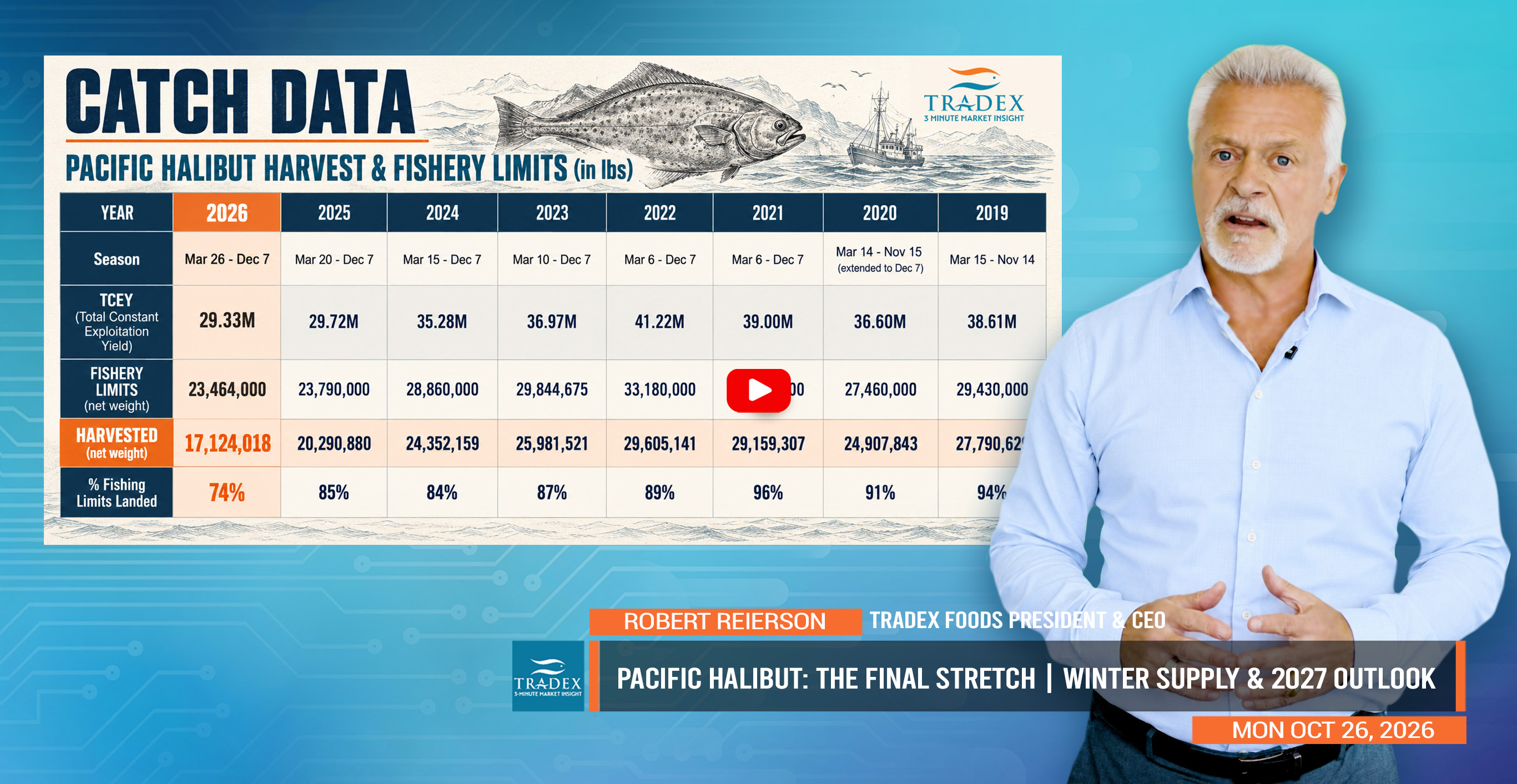
As of October 20, reported coastwide catch reached 17.12 million pounds, representing 73.9 percent of the 23.18-million-pound fishery limit. This total includes commercial and recreational catch, along with estimated discard losses. The remaining coastwide allowance therefore does not represent commercial supply alone, nor does it indicate how much finished product is available for purchase. Reporting timing also affects the headline figure. Approximately 561,000 pounds of the 1.61-million-pound increase since October 1 came from newly reported British Columbia recreational catch, rather than additional commercial harvest.
Catch Volumes and Allowances Have Declined
Full-season reported catch fell from 25.98 million pounds in 2023 to 20.29 million pounds in 2025, a decline of approximately 22 percent. The 2026 total is still accumulating, so a final comparison will depend on completed season reporting. The broader coastwide allowance, known as Total Constant Exploitation Yield (TCEY), also accounts for bycatch and other fishing losses beyond the fishery limits used in the season tracker. It declined 15.8 percent in 2025 to 29.72 million pounds, followed by another 1.3 percent reduction in 2026 to 29.33 million pounds. Industry reporting has described the 2026 allowance as the lowest in IPHC history.
Major Commercial Regions Approach Their Limits
Commercial utilization is considerably further advanced than the coastwide figure suggests:
Southeast Alaska: 90.3 percent utilized.
Central Gulf of Alaska: 88.6 percent utilized.
British Columbia: 86.2 percent utilized.
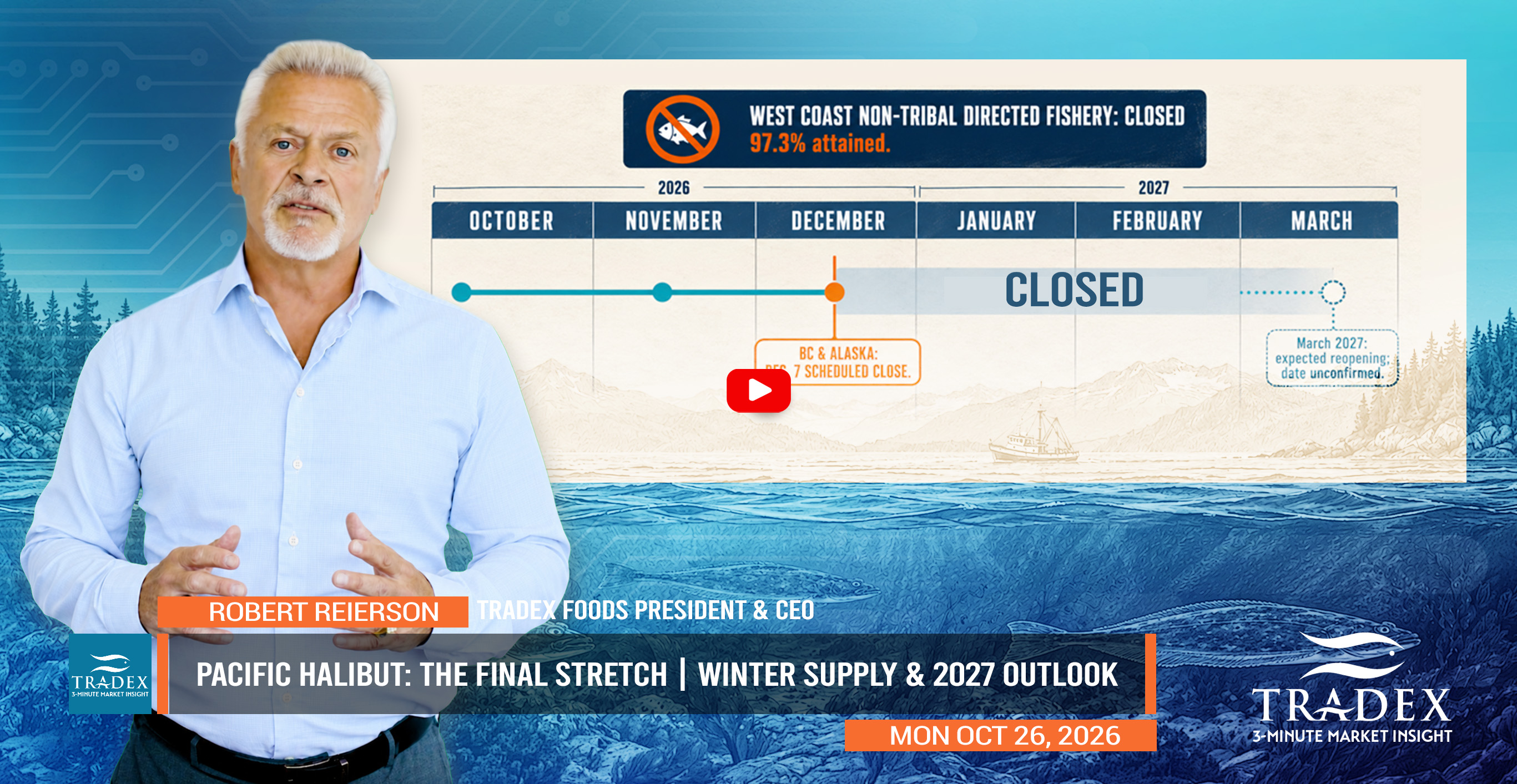
Together, these three commercial sectors have approximately 1.50 million pounds remaining against their listed limits. Western Gulf utilization stands at 83.5 percent, while Aleutian and Bering Sea areas range from approximately 48 to 70 percent. Remaining quota is therefore unevenly distributed and may not translate into readily available product in buyers’ required sizes, specifications and delivery windows. The West Coast’s non-Tribal directed commercial fishery has already closed, reaching 97.3 percent of its allocation. British Columbia and Alaska’s directed commercial seasons are scheduled to close December 7.
Bycatch Allowances Draw Attention Ahead of 2027
Against a backdrop of historically low halibut catch limits, Laine Welch of Alaska Fish News highlighted approximately 10.5 million pounds in proposed annual bycatch allowances for 2027 and 2028. Her report draws attention to how halibut losses in fisheries targeting other species are managed alongside restrictions on directed halibut fishing. The cited Council figures include both trawl and non-trawl allocations. They represent proposed limits on incidental fishing losses, rather than forecasts of actual bycatch. Final specifications remain subject to Council decisions and federal rulemaking. The 2027 Pacific halibut catch limits are expected to be set at the IPHC Annual Meeting, January 25–28, 2027, in Victoria, British Columbia. Those decisions will provide clearer direction for next season’s supply outlook.

Advertise Here: advertising@tradexfoods.com
Winter Buying Outlook
Earlier internal market feedback indicated that fresh demand absorbed most production, leaving limited volume entering freezers and fillets and fletches largely committed to programs.
Current inventories and pricing require confirmation. However, with major commercial fisheries approaching their limits, opportunities to replenish frozen supply from this season’s production are narrowing.
Our Recommendation for Seafood Buyers
Our recommendation is to confirm winter requirements, verify available frozen inventory by size and product form, and secure essential coverage against confirmed offers. Monitor remaining production and January’s catch-limit decisions before extending purchases beyond established demand.
Follow Tradex Foods on LinkedIn, Facebook and X for mid-week updates, and subscribe to 3-Minute Market Insight for the latest seafood market developments.
--- If you’re not already, be sure to subscribe to our 3-Minute Market Insight for seafood updates and insights delivered right to your inbox.