
Loading

- Home
- About Tradex
- Products & Services
- Foodservice
- Seafood News
- School of Fish

EP 817 | AIRED 11/02/2026
Fall Salmon Market Update: Alaska & BC Chum, Pink, and Coho Harvests
November 2, 2026 - Japan’s fall chum season has provided little relief since the early October update, while October pricing reports show Chilean farmed coho becoming more expensive. With limited remaining production and higher replacement costs, winter purchasing decisions increasingly depend on confirmed inventory and suitable alternatives.
Our recommendation is that buyers reassess winter coverage as availability and replacement costs become increasingly important.

Hokkaido’s reported chum harvest reached approximately 5,500 metric tonnes through October 22, down about 55% from the same period in 2025. The continued shortfall is tightening the outlook for chum meat and salmon roe rather than providing the autumn supply recovery buyers had been monitoring. Fishing continues through November, with some areas extending into December; however, the remaining season does not guarantee a recovery. Beyond the immediate commercial implications, weak returns are raising concerns about securing sufficient broodstock and eggs for hatchery production and future salmon releases.

Japanese Chum and Roe Prices Reflect Tight Availability The price impact was already evident in early October. An October 9 SeafoodNews report, citing Minato Shimbun, placed female chum prices at Japanese producing areas around ¥4,500–6,000/kg, equivalent to approximately US13–17/lb. Female prices were reported at nearly three times year-earlier levels. Fresh salmon roe sacs in Sapporo were around ¥30,000/kg, or approximately US$86/lb. These figures describe Japanese domestic fresh-market prices, not North American wholesale quotations or export prices for frozen chum and finished ikura. The U.S. dollar equivalents are rounded currency and weight conversions of the reported October indications, rather than confirmed November offers.

Advertise Here: advertising@tradexfoods.com
Chilean Coho Replacement Costs Also Move Higher
Pressure has also reached Chilean farmed coho. October 9 reporting from Undercurrent News placed Japanese wholesale prices for frozen headed-and-gutted coho around ¥1,250/kg, equivalent to approximately US$3.60/lb. Separately, Chilean export offers were approaching US$8.00/kg, or roughly US$3.60/lb, on a cost-and-freight basis. These quotations represent different stages of the supply chain and should not be treated as North American landed prices.
Japanese processors were struggling to pass higher raw-material costs into finished-product prices, while importers warned that rapid increases could weaken demand. Coho remains an alternative for suitable programs; however, buyers should compare current replacement costs rather than assume that switching species will necessarily provide a lower-cost option.
Alaska and Russia Offer Limited Remaining Production
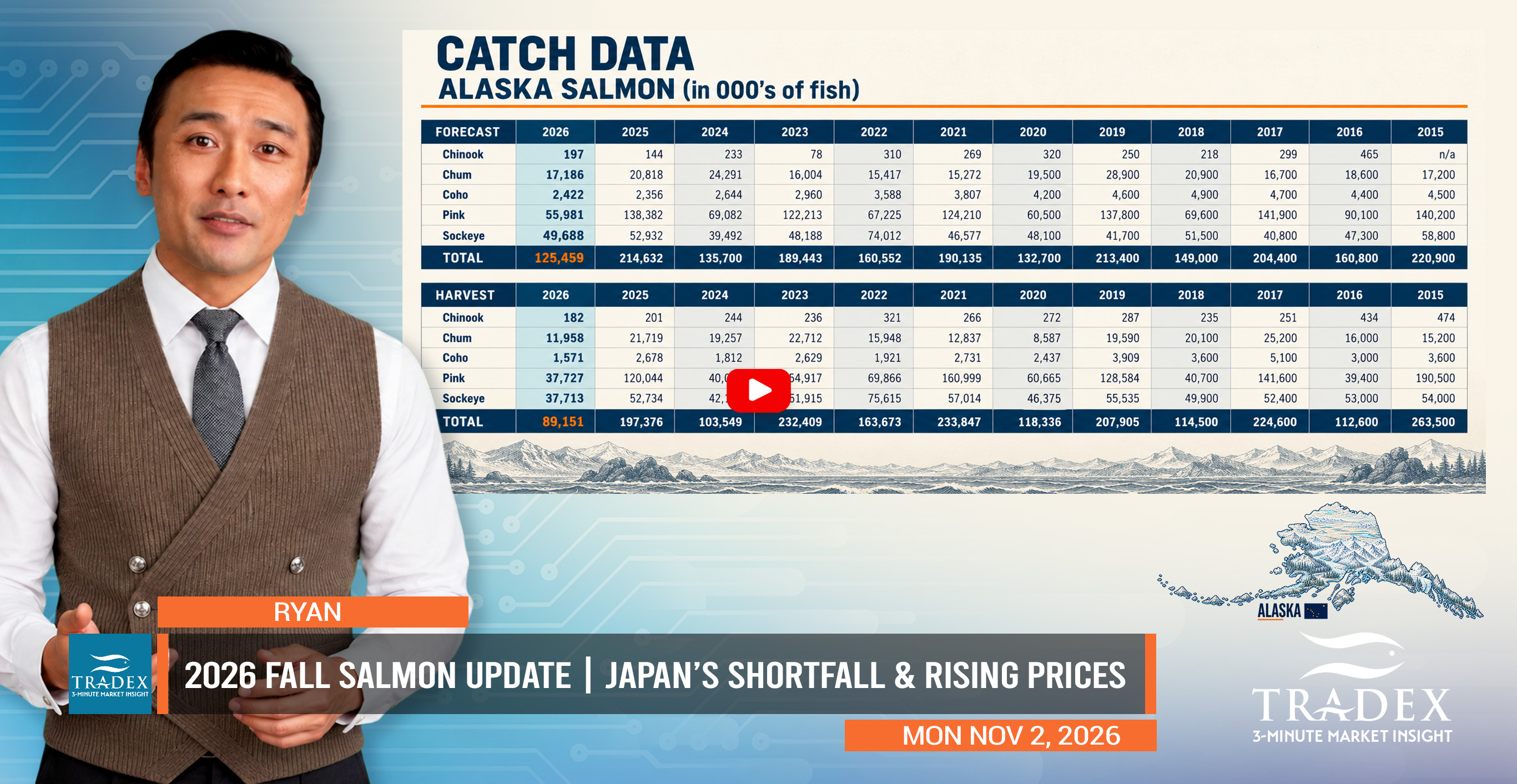
Through October 25, Alaska had reported approximately 89.15 million salmon, while Russia’s cumulative harvest stood near 99,300 MT, representing only 43% of its corrected forecast. Russia added just 28 MT during the latest three-day monitoring period, indicating that meaningful commercial production was effectively concluding.
For U.S. buyers, accessible supply is further constrained by restrictions prohibiting Russian-origin salmon even when processed into another product in a third country. Origin therefore remains an essential consideration when evaluating replacement offers.
Southeast Alaska’s 2027 Pink Forecast Offers Longer-Term Encouragement
NOAA and the Alaska Department of Fish and Game released an encouraging forecast on October 28, projecting a 67 million-fish pink salmon harvest in Southeast Alaska for 2027. If realized, that would be the region’s largest pink harvest since 2013. This is a Southeast Alaska forecast, not a statewide Alaska projection.
The historical comparison used for this report places Southeast Alaska’s contribution at roughly a quarter to a third of Alaska’s pink salmon production, although its share varies by year. That makes the regional forecast an important early signal for buyers monitoring next season’s supply potential.
However, the forecast carries a wide 80% prediction interval of 42–98 million fish, highlighting substantial uncertainty. Any additional supply would arrive next summer—not in time to address this winter’s requirements.
Our Recommendation
Our recommendation is that buyers secure committed winter chum, roe and other wild-salmon requirements against confirmed inventory, while comparing current offers for coho and acceptable alternatives by specification, origin and delivered cost. Remaining fall production should be treated as incremental supply rather than a reason to expect broad availability or substantial price relief.
The encouraging 2027 pink salmon outlook warrants monitoring, but winter coverage and next summer’s potential supply should remain separate purchasing considerations.
--- If you’re not already, be sure to subscribe to our 3-Minute Market Insight for seafood updates and insights delivered right to your inbox.